Tool I built · Personal project · 2026
Garage Tote Inventory
A phone-first inventory app for the numbered storage totes in our garage. My household uses it every day to find things, track what's been borrowed and keep a shopping list.
At a glance
| Role | Product owner, builder and operator, using Claude as my coding partner |
|---|---|
| Users | My household, on iPhones as a home-screen app |
| Platform | Self-hosted on a Raspberry Pi: a Python server and one-page web app, with nightly offsite backups |
| Status | Live and in daily use; self-hosted since June 2026 |
What it does
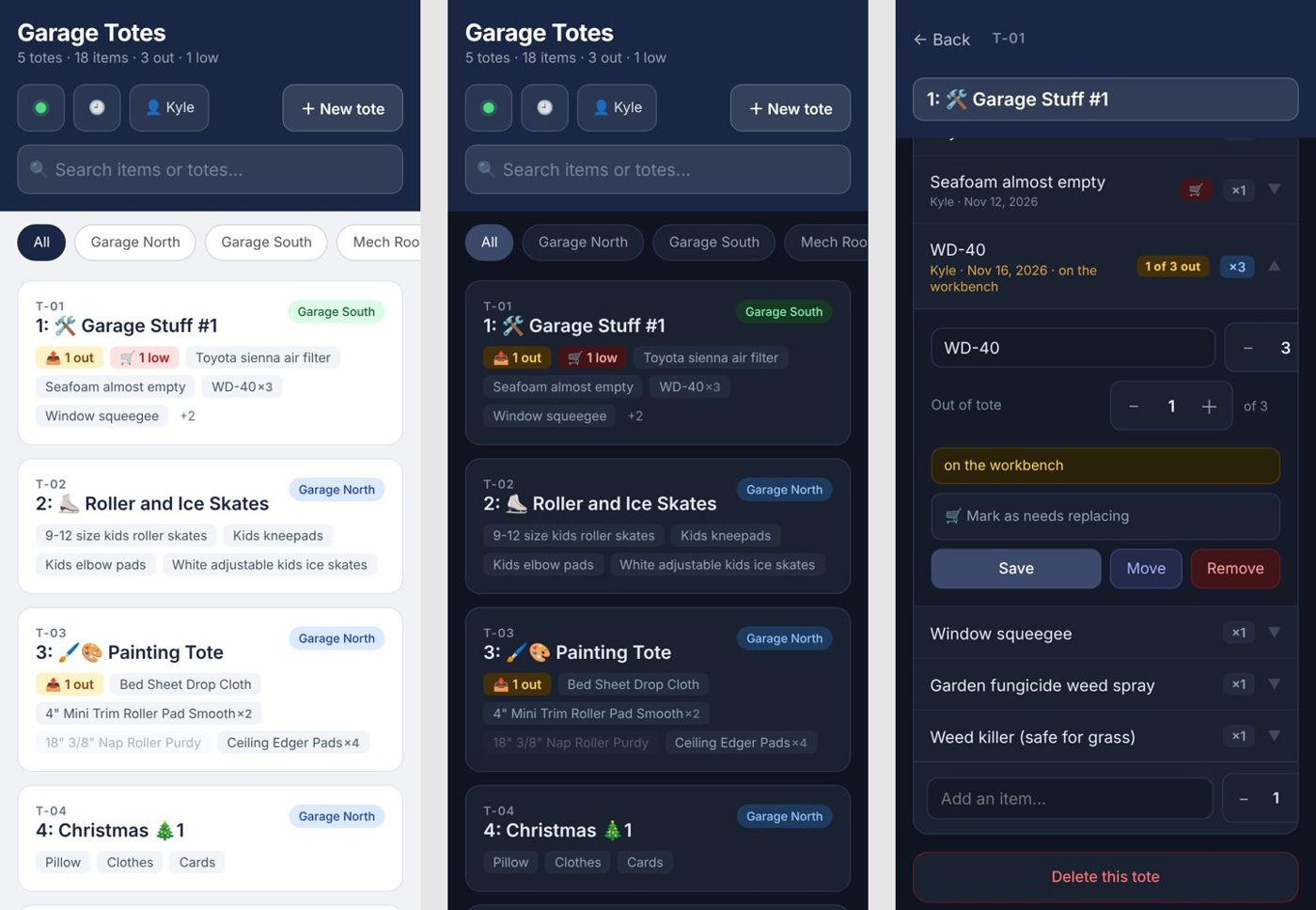
- Find anything fast. Each tote shows its location and items; live search jumps straight to the matching item.
- Track what's out. Mark an item as taken out, even part of a quantity ("1 of 3 out"), with who took it, when and where it is.
- Shopping list. Flag an item as needing replacement, and a cross-tote list builds itself.
- Who did what. Every change is stamped with who made it, and an activity log shows recent events.
- Backup health. A status light turns green, amber or red based on how recently the nightly backup succeeded.
How I built and run it
I ran this like a small product: ship a simple version, move it to infrastructure I control, then harden it.
- Started simple. The first version was a hosted web page backed by a cloud data service.
- Moved it in-house. In June 2026 I migrated everything to a Raspberry Pi on our home network, removing subscriptions and cloud dependency. Remote access runs through our VPN only.
- Protected the data. Every save writes a local snapshot (the last 200 are kept), and a scheduled job copies the data to Google Drive nightly. Restore steps are written down for both a bad edit and a dead SD card.
- Audited it. In November 2026 I ran a two-part AI review of the code and design. Every fix was deployed and tested at several screen widths in both themes.
- Wrote it down. A handoff document covers architecture, data model, deploy steps, recovery and hard-won lessons, so someone else can maintain it.
Trade-offs I chose on purpose. If two phones save at the same moment, the last save wins; snapshots make any lost edit recoverable, so I accepted that risk at family scale. Offline mode would need certificates on every phone, so I deferred it. The backlog is ranked, with printable QR labels per tote next.
What it shows about how I work
It's a personal project, but it follows the habits I bring to every system: start with the real need, own the infrastructure, plan for failure with tested backups, review the work, choose risks on purpose, and write things down so the system doesn't depend on me.